Showing posts with label watercolor. Show all posts

Friday, July 29, 2016

MASK UP WITH MARVELOUS MASKING FLUID

Resist fluid is a favorite of mine that works
well with fluid acrylics.
Here's a finished example, below, and I'll provide the steps (and some pointers) below that!
art+blog, acrylics, how-to
After the latex was removed, I painted parts of a few exposed lines.
Resist fluid makes an exciting addition to any painter’s resources.
painting

I didn’t have a Fineline Resist Pen at the time, so I applied lines and dots with a painting knife. Always apply this product to dry paper! The latex rubbed right off my knife when I was finished.

Other application tools you might use include wooden skewers, toothpicks, old (bad) brushes, even dip pens. Most resist fluid doesn’t thin with water, but you could try ammonia.

If you make a mistake, just let the masked line dry and remove from the paper.

ART TIPS: Don’t try drying the masking fluid design with a hot hair dryer! (But don’t leave the fluid on absorbent paper for a very long time. Also, masking fluid becomes gummy if you leave the cap off too long.
painting, how-to, mask, resist
Let the fluid dry before you go to the next step!
When my mask was dry, I painted with watercolors, although fluid acrylics are fine. (Granulating medium made the gray areas more interesting.)
You MUST let your painting dry well before removing the masking fluid! The latex can be removed with a rubber cement pick-up tool, but I just rub a finger over the masked lines and shapes.
I wanted to color some of the white lines,
so I used blue at right and left edges.
But do leave some white, darn it!
The original white paper will
make your painting sparkle.
 
 THANKS FOR VIEWING THIS POST!

Saturday, January 17, 2015

MORE ART PRODUCTS & EFFECTS ON A WET SURFACE

In the previous post here, you'll find visual texture effects and more on watercolor paper. Today we'll use the same type of watercolor paper to experiment dry-on-wet with a number of waterbased products. If paper becomes too dry, re-spray with water as needed.

art+blog, Guhin
Water soluble art media
Scrape dry pigment from color sticks with a knife, or rub the color over rough sandpaper. As you'll learn, I only had really good luck with the latter with one of the  the above water-soluble materials. (But that's just me.)

#1 is Cretacolor wax crayons with
knife scrapings onto a wet strip.

#2 is Portfolio water soluble oil
pastels (LOVE THEM!)
art, tute, tutorial
The last two are my favorite effects here.


#3 is Weber Costello WaterCrayons...
do they even make them anymore?


#4, I used Crayola Watercolor
Colored Pencils for a
fine, misty effect
in water.


#5 was done with shavings of
Neocolor II Watersolubles.

And do try dropping dry
crystals and concentrates
on damp paper.
Order it here!
 Brusho is still my all-time
"bombastic" product for
a strong pigment on
a wet surface...it blooms
beautifully! Love it! See Dyes
in Dry Form in my book,
CREATING DECORATIVE
PAPER. 


art+blog
I "heart" my followers!

Saturday, January 10, 2015

MATERIALS FOR DIFFERENT MIXED MEDIA EFFECTS

Elsewhere on this art blog I have previously discussed a number of media and common household products to create many textures and to use with a wide variety of techniques. See plastic food wrap here, and masking fluid here.


art+materials, Guhin, effects
You can even use rubber cement as a resist material!
You can imprint designs with fabrics, too! Below are a few other techniques to remind you of the possibilities!
Today we'll use water-soluble media (liquid watercolors, fluid acrylics) on cold press watercolor paper which I taped down and pre-wet with water.
In the first example, I washed in deep color and placed wooden sticks in it at once. Then I let it dry with the sticks in place.   
tute, technique
The wooden dots did not work!


tutorial. painting
Ok, MY result isn't terribly good.
Try other items! You'll have better luck!
Another technique: Scratch into wet paper before washing color over...the broken fibers absorb color differently than the rest of the paper.   
painting, how-to
This method is good for scribbles, lines, grasses....
Thanks for viewing this post!


Sunday, September 7, 2014

EASY IMPRINTING OF WATERCOLOR OR LIQUID ACRYLIC

TWO SIMPLE TECHNIQUES!
 
The first method uses plastic shapes cut from shopping bags. I made boulder-like forms by wetting watercolor paper, placing the plastic shapes firmly down on the damp paper, and painting washes around them.
Let dry before removing the plastic. Then develop the painting further. See mine below.
how-to, imprinting
I have a video of making this on YouTube!
The next technique is also a resist method for imprinting a painting. I wanted a garden-y, trellis-y effect for a painting with leaves.
Fold waxed paper, open it up again, and lay it into a wet wash of vivid ink or fluid paint. Press it down with a sheet of glass on top. Let dry before removing the glass and the waxed paper.

technique, mixed-media
Waxed paper texture at work! Folded examples at right.


Embellish and make marks as desired to
achieve the effect you want!
mixed-media, P.Guhin
This is a detail of the finished piece.


Sunday, May 18, 2014

IMPRINTING: A GREAT WAY TO ADD VISUAL TEXTURE!

USE FLUID PAINTS TO TRANSFER PATTERNS

(P.S., The winners of yesterdays's giveaway were Gil in the UK and Susie! Congrats to them.)

The imprinted paper shown below was done with damp watercolor paper, a sheet of glass, and a crocheted piece. I pressed the lacy fabric to the paper before flooding it with intense watercolor. Then I quickly put the glass on top and a heavy book on that! The next day I removed the "sandwich."

method, how-to
Not a finished work, but paper to be used in collage - mixed-media.


For the "fishy" painting, I cut a plastic bag into curvy shapes
(see the light, fish-like forms below) and lay them on the damp
paper first. They stuck there and formed a type of resist. You could
also use shards of glass or Plexiglas.
texture, tutorial
I used a fishnet...how appropriate!

Sunday, July 21, 2013

OIL PASTEL AS A RESIST WITH WATER-BASED PAINT

Traditional oil pastel (not the water-soluble kind) 
acts as a resist with watercolors, liquid acrylics, 
thinned tempera or gouache.

I used good, smooth watercolor paper and applied the oil pastel heavily in the line design seen below.
art tutorial, how-to
Yup, this is a simple resist demonstration!


Then I washed in some diluted gouache.
resist painting
I added a few white accents later.
Thanks for viewing this post, from the mixed media manic herself!

Monday, May 13, 2013

GORGEOUS ARTWORKS BY GUEST BLOGGER CHRIS MARSHALL, PAINTER - COLLAGE ARTIST


(Note from Paula, the original Mixed Media Manic: ) I'll just quickly introduce my guest blogster and then get out of the way! I "met" her on LinkedIn, where she is an enormously  supportive and encouraging presence. Chris Marshall is mad about color (or, as Chris puts it, "colour") and texture. She lives in Perth, Western Australia, with her artist/photographer husband and teammate, Steve, with whom she partners in their business, Marshall Arts. In addition, she coordinates an art centre and gallery! Chris works in acrylics, watercolors, pen, mixed media and the digital arts and maintains a sensational website at www.marshallarts.com.au   Now here's Chris!

Hi, everyone! I’m a mixed media / collage and digital artist and I have fun with my art. I work totally intuitively, love to experiment and let my art come from deep within me so every artwork has something of me in it. I love looking at all types of art but when it comes to my own art, I'm happy in my own skin. That is, I don't aspire to be like anyone else and I don't like being labelled or put in a box. 
Chris Marshall, mixed media art
Blue Mountains Odyssey, by Chris Marshall, features
texture made from tickets, brochures and other  info collected on  holiday.
I just LOVE mixing my media and creating something intriguing out of often unrelated materials and objects. I work on paper (heavy watercolour paper, 638gsm with a rough surface), canvas or board. I work totally intuitively, sometimes starting with an artwork in mind (eg Blue Mountains Odyssey, above); sometimes inspired by something I find (eg Out of the Blues, below); sometimes I just play with materials and/or a technique and see what happens (eg Absorbed and a Hint of Autumn); and other times I’m totally inspired by the feel of a place that I have been, like Intriguing Wetlands and my Ningaloo series. 
mixed media art, painting
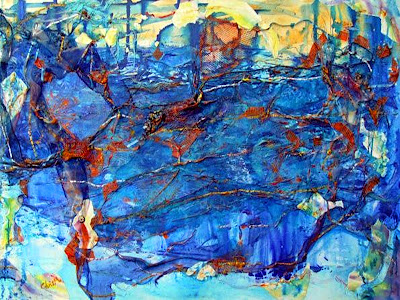
Out of the Blues, which began on an impulse when I picked up a second-hand scarf for $2.
because I was so taken with the beautiful colors.
As watercolours was the first medium that I used, I like washy looking backgrounds and the magic that happens when the wet liquids of different viscosities combine; I often start that way, mixing watercolours, acrylic paints and inks, sometimes also using a light modelling compound in the background. I also often use fabrics of different textures in my surface treatment.                                                                                                                       
I don't have a plan for the finished work but I do go rather zen and let the artwork lead me where it wants to go. I often turn the work in all four directions and work on it from all four angles. Sometimes I work on the painting thinking that it will be that way up, but then turn it around and it heads off in a completely different direction! I find this way of working wonderfully exciting and very creative. Sometimes I am amazed by the finished artwork, wondering where on earth that came from.
Chris Marshall, fine art
Absorbed,  Japanese papers collaged onto a heavy watercolour
paper (rough surface),then caran d'ache crayons on top.

collage/painting, fine art, mixed media
A Hint of Autumn,  started by blowing watercolours
around with a straw! Again it uses Japanes papers then wooden
 buttons, dyed fish scales, threads and other bits and bobs.
I do sometimes use words in my collages but tend to bury them in the artwork so they are not obvious. I generally use impasto gel as my "glue" but usually bleed in some colour while still wet so the added piece sort of emerges from the background.


I do like the finished piece to have unity. I personally don’t like the sort of stuck- on look, so wherever the journey of my artwork takes me, I bring it all back together either with colour, with my penwork or with painted marks and repeated patterns so that everything looks as though it belongs.

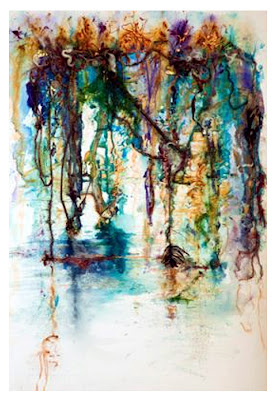
Intriguing Wetlands, below, is inspired by the reflections, the stillness, the birdlife of the wetlands....the washy acrylic and ink background with twigs and leaves,  coloured wool, combed out staples of wool that Spinners use (here representing bird life),  a bit of jewellery, some paua shell, some green netting. Throughout I try to match and echo the colours so that you have to look really closely to work out what is part of the background and what is foreground, what is painted and what is a collaged. I'm trying to capture the look and feel of the wetlands when you stare into the water and can't work out what is above the water, what is under the water and what is a reflection.
Chris Marshall, fine art
Intriguing Wetlands by Chris Marshall
collage, painting, mixed-media
Ningaloo IX, Hidden Depths, the latest in a series.

Detail of Ningaloo IX, below, shows the dyed fish scales, bits of orange bag
(the white bits are where gesso has been dribbled through the orange bag and allowed to find its own path). There is also some shredded japanese paper  which has fantastic fibery threads. As you can tell, I often use different japanese papers, especially those with long fibres. Some of them go quite transparent when you stick them on so that all you see afterwards are the individual fibres. Fantastic!

Detail of Chris Marshall's Ningaloo IX

Thanks to Paula for giving me this opportunity to share my passion for mixed media/collage with you. - Cheers, Chris M.


Friday, July 8, 2011

DRAWING GUM MAKES A GORGEOUS PATTERN!


This design on paper was SO000 easy to do, and it looks rather striking, yes? I used plain old manila paper (sort of yellow-tan).
Drawing gum is a masking fluid. I put a blob of it on the paper and blew it around through a drinking straw. Thus the branching lines.
When a few moments had passed, I gently washed with blue watercolor (dye would work, too), over the entire page. It turned greenish on the yellowish paper.
After that was dry, I rubbed the drawing gum off with my thumb. 

Friday, April 29, 2011

BEAUTIFUL BATIK-LIKE EFFECT IS SOOOO SIMPLE TO DO!

White drawing paper is fine for this technique. Wet it on both sides (I dunk it in the sink) and then crumple it into a ball.


Open it up gingerly, without tearing
the paper. Lay it flat onto freezer paper or newspaper. Paint with vivid, full-strength watercolors and a wide brush, all over the paper. Even this side (below) is rather nice, isn't it?


Finally, flip the paper over and take a peek at the back...you may prefer that side.

Tuesday, March 15, 2011

This is the Cutest Watercolor Set Ever!


Just got this travel kit made by Sakura. It has a reusable waterbrush, lots of great colors, a palette, and sponges. Love it!

Wednesday, March 9, 2011

Practice, Practice, Practice! Watercolor Painting.

I don't know about you, but I find watercolors challenging. The orbs with highlights created by the white of the paper, and the bars with two colors blending--both ideas are great for any beginner in watercolor painting to try.
These studies appear courtesy CPi, the publisher of the
Complete Photo Guide to Creative Painting, available now!